
A Special Analytical Report on the U.S.-Iran-Israel Conflict and Its Expanding Human Cost
Dr. Alhaji K. Tarawally | International Relations Scholar | Adjunct Professor | Schiller International University
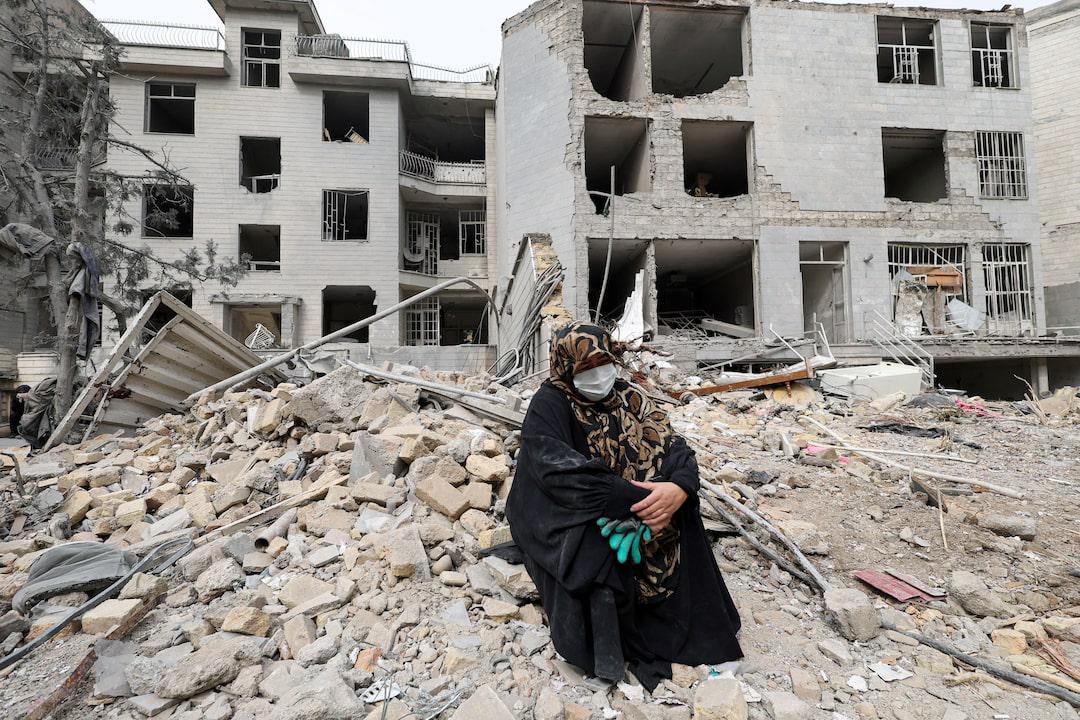
On a sweltering afternoon in the Bamani district of southern Iran, residents of Kouhestak and its surrounding villages turned on their taps and found nothing. Two concrete water storage reservoirs — a 500 cubic meter tank and a 2,000 cubic meter tank — had been reduced to rubble overnight by American airstrikes. The temperature outside was hovering between 45 and 50 degrees Celsius. There was no groundwater sufficient to replace what had been destroyed. Twenty thousand people were without safe drinking water.
This is what the war looks like now, more than 100 days in.
Origins and Escalation: How the War Began
What began as a U.S.-backed Israeli campaign targeting Iran’s nuclear and military infrastructure has metastasized into something far broader, far more dangerous, and far more costly than the architects of the original strikes had publicly anticipated. The war’s early phases were framed in Washington as targeted, decisive, and limited in duration. US President Donald Trump said the war would last weeks. It has now lasted well past 100 days, reshaping the geopolitics of the Middle East, straining America’s alliances, fracturing its domestic political consensus, and sending economic shockwaves across the globe.
The conflict drew in the United States after Iran responded to Israeli strikes on its nuclear facilities with retaliatory attacks on American assets in the region. What followed was a cycle of escalation that neither side has yet been willing — or able — to permanently break.
The Strike on Southern Iran: Civilian Infrastructure in the Crossfire
U.S. Central Command confirmed carrying out a new wave of strikes on the southern Iranian cities of Jask and Sirik, as well as Qeshm Island, a strategically critical landmass positioned at the mouth of the Strait of Hormuz — one of the world’s most vital maritime chokepoints. CENTCOM described the strikes as “a proportional response to unjustified Iranian aggression,” citing Washington’s assertion that Iran had deliberately downed a U.S. Army Apache helicopter.
The military said it targeted communications and radar facilities. What was not mentioned in the initial American statement was the destruction of civilian water infrastructure.
Abdolhamid Hamzehpour, CEO of the Hormozgan Province Water and Wastewater Company, was unambiguous in his account: “Two concrete reservoirs and their associated mechanical infrastructure were destroyed. Water distribution has now been suspended across villages in the Bamani district and Kouhestak.”
Iranian state television added a stark detail: the area has insufficient groundwater reserves to compensate for the loss.
Both things, as the facts on the ground make clear, can be simultaneously true — that the U.S. military struck legitimate military targets and that civilian water infrastructure was destroyed in the same operation. The laws of armed conflict draw a sharp line around civilian necessities such as water supply. That line, in Sirik County, now lies in rubble.
Iran’s Foreign Minister Abbas Araghchi offered a characteristically measured but unmistakably firm response: “Iranian forces will leave no attack or threat unanswered.”
Within days, that promise was kept.
Kuwait Burns: The War Crosses a New Border
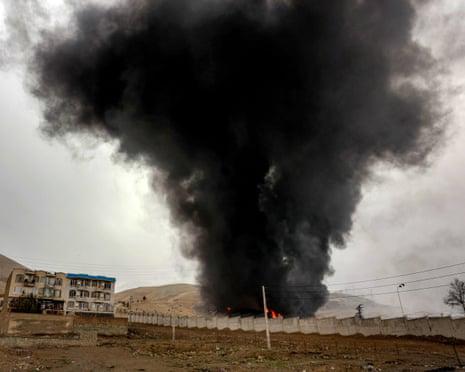
On a Wednesday that Kuwaiti authorities will not soon forget, Iranian drones and missiles struck Kuwait International Airport — killing one person, wounding more than 60, destroying the radar system, setting fuel tanks ablaze, and damaging terminal buildings and diplomatic missions. The airport was briefly shut down before Kuwait Airways and Jazeera Airways cautiously resumed operations after implementing emergency safety measures. The single fatality was identified as an Indian national — a reminder that in regional wars, it is often third-country civilians who pay the first price.
Iran’s Islamic Revolutionary Guard Corps claimed responsibility and framed the attack not as provocation but as retaliation. The IRGC statement declared that the Ali Al Salem Air Base in Kuwait — which hosts American military helicopters — as well as the U.S. Navy’s Fifth Fleet headquarters in Bahrain, had been struck. The language was deliberate and ominous: the IRGC described these attacks as an “initial response,” explicitly warning that stronger retaliation could follow.
A spokesman for Iran’s parliament National Security Committee put it with cold clarity: “The United States understands the language of missiles better than the language of diplomacy.”
The United States offered a contesting account. U.S. Central Command denied that its bases had been successfully hit, asserting that Iranian ballistic missiles failed to reach their targets and that American forces had downed multiple drones. Bahrain’s Defense Ministry corroborated elements of the American narrative, confirming that its military intercepted and destroyed three missiles and a number of drones fired by Iran.
But an airport was on fire. A person was dead. And the fragile ceasefire announced on April 8 — already violated repeatedly by both sides — was now, by any honest assessment, effectively dead.
The Ceasefire That Wasn’t
The April 8 ceasefire had been greeted with cautious optimism by diplomats and war-weary populations across the region. It did not hold. What followed was a weeks-long pattern of mutual accusations, selective violations, and escalating strikes, each side insisting the other fired first, each strike generating the justification for the next.
The sequence that produced the Kuwait airport attack follows this pattern with grim precision. The U.S. struck Qeshm Island. Iran, framing the attack as “brazen and blatant aggression,” launched drones and missiles toward Kuwait and Bahrain. The U.S. intercepted many of them while simultaneously denying any of its assets were damaged. Iran called it an “initial response.”
The word initial carried weight. It was not an ending statement. It was an opening bid.
Perhaps most consequentially, Iranian media outlets with close ties to the Revolutionary Guard reported that Tehran had suspended communications with ceasefire mediators. A week before the Kuwait strike, diplomats had been cautiously describing the contours of a potential deal. By the time the airport radar system was destroyed, those communications had gone silent.
A deal was on the table. Now there is no table.
The Global Ripple Effects: Food, Oil, and Economic Fragility
The war’s consequences extend far beyond the borders of Iran, Kuwait, and the Gulf states where missiles and drones are trading in the night sky. The World Food Program’s acting Executive Director delivered a sobering assessment this week, warning that the conflict’s ripple effects are “increasing the risks of acute hunger for millions of people around the world.”
The mechanism is straightforward and devastating: when the Strait of Hormuz is threatened, global oil prices spike. When oil prices spike, food production, transport, and distribution costs rise accordingly. For populations already living on the margins, that arithmetic is lethal.
“When the price of food goes up 20 to 30 percent, they eat 20 to 30 percent less,” the WFP official said.
Oil stockpiles in the world’s wealthiest nations have fallen to their lowest levels since 2003 — a data point that will focus the attention of finance ministers and central bank governors in ways that humanitarian appeals alone cannot. The world’s dependency on Persian Gulf energy routes has not diminished despite decades of pledges toward energy independence. The vulnerability has been deferred, and it is now arriving.
Washington Divided: A Rare Defeat for Trump
The war has not only exported instability outward — it has generated genuine political fracture within the United States itself, and in a vote that captured the growing unease on Capitol Hill, the House of Representatives passed a resolution 215 to 208 to withdraw U.S. troops from using military force against Iran absent explicit congressional authorization. The measure represented a rare and meaningful defeat for President Donald Trump.
Every Democrat present voted for the measure. They were joined by four Republicans: Thomas Massie of Kentucky, Warren Davidson of Ohio, Brian Fitzpatrick of Pennsylvania, and Tom Barrett of Michigan. Massie and Davidson have been consistent critics of the conflict on libertarian and constitutional grounds. Fitzpatrick and Barrett represent competitive swing districts where public opinion on the war’s continuation is far less settled than in safely Republican constituencies.
The significance of the vote should not be overstated — nor should it be dismissed. Trump is expected to veto the resolution, and supporters of the measure do not have the two-thirds majority required to override it. House Foreign Affairs Committee Chairman Brian Mast of Florida was dismissive, calling it “a total BS vote” and “a stupid political vote.”
But beneath the partisan framing lies a constitutional and moral question that does not dissolve easily: under what authority, and toward what defined objective, is the United States conducting a sustained military campaign against a sovereign nation? More than 100 days in, those questions have not received satisfying answers from the executive branch. The House vote, symbolic as it may be in the immediate term, ensures they will continue to be asked.
Former Deputy National Security Advisor Victoria Coates, reflecting on the administration’s position, emphasized the ongoing nuclear dimension of the conflict, pointing to Trump’s parallel diplomatic track — nuclear talks with Tehran that, at least until communications were suspended, represented the other lane of a two-track American strategy.
That lane is now, at minimum, blocked.
Iran’s Internal Calculus: Defiance and Public Mobilization
Inside Iran, the political dynamics of the war are complex. On May 30, thousands gathered at Revolution Square in Tehran, holding Iranian flags and posters of the late Supreme Leader Ali Khamenei. The image was one of nationalist consolidation — the kind of domestic rally that authoritarian governments under external pressure often succeed in generating, whatever the private suffering of their populations.
The Iranian government’s public posture has been one of unwavering defiance. Foreign Minister Araghchi’s statements have been consistent: every attack will be answered. The IRGC’s framing of the Kuwait operation as an “initial response” was not accidental language — it was a signal to Washington, to regional capitals, and to the Iranian public that the Islamic Republic is neither deterred nor finished.
Yet beneath that posture, the pressures are real. The destruction of water infrastructure in Hormozgan Province is not an abstraction for the people who live there. Sanctions, conflict, and now direct strikes on civilian utilities are compounding vulnerabilities that Iran’s government has limited capacity to address, particularly in a region already defined by water scarcity and extreme heat.
What International Law Says — and What It Cannot Enforce
The destruction of drinking water infrastructure serving 20,000 civilians in 50-degree heat raises direct questions under international humanitarian law. Article 54 of the Geneva Protocol I explicitly prohibits attacks on “objects indispensable to the survival of the civilian population,” including drinking water installations. The United States has ratified elements of international humanitarian law and military doctrine that formally incorporate the principles of proportionality and distinction.
CENTCOM’s statement that it targeted communications and radar facilities does not resolve the question of whether the water reservoirs were incidental collateral damage or direct targets. If incidental, the question becomes one of proportionality — whether the military advantage anticipated was sufficient to justify a foreseeable harm of this magnitude to civilians. If direct, the question is far more serious.
No international tribunal has jurisdiction to compel accountability in real time. The United Nations Security Council remains paralyzed on the conflict, as it has been since the first strikes, by the structural dynamics of the veto. What international law provides in this situation is a moral and legal framework for judgment — and a historical record for eventual reckoning.
One Hundred Days and Counting
On day one, the framing was surgical. Targeted. Proportional. Limited. The word “weeks” was used with confidence.
On day 101, a water supply serving 20,000 people is gone. An international airport in a third country is burning. A ceasefire is dead. Negotiations have gone silent. The U.S. Congress has voted — symbolically, but meaningfully — to question the president’s war authority. Global food prices are climbing. Oil reserves are at a 23-year low.
The war that was supposed to last weeks is destroying water supplies in a heat wave and setting airports alight in countries that are not even parties to the original conflict.
The Middle East has seen many wars. What distinguishes this one is the speed of its geographic and humanitarian expansion, the fragility of every pause that has been called a ceasefire, and the absence, on any side, of a clearly articulated end state. Victory has not been defined. The conditions for a sustainable peace have not been publicly proposed. And the missiles keep flying.
Twenty thousand people in southern Iran went to bed last night without water in 50-degree heat.
That is not a footnote. That is the story.
<><><><><><><><><>
This report was compiled from statements by U.S. Central Command, Iran’s Foreign Ministry, the Islamic Revolutionary Guard Corps, Kuwaiti authorities, Bahrain’s Defense Ministry, the World Food Program, members of the U.S. House of Representatives, and regional news agencies. The conflict remains active, and conditions are subject to rapid change.