
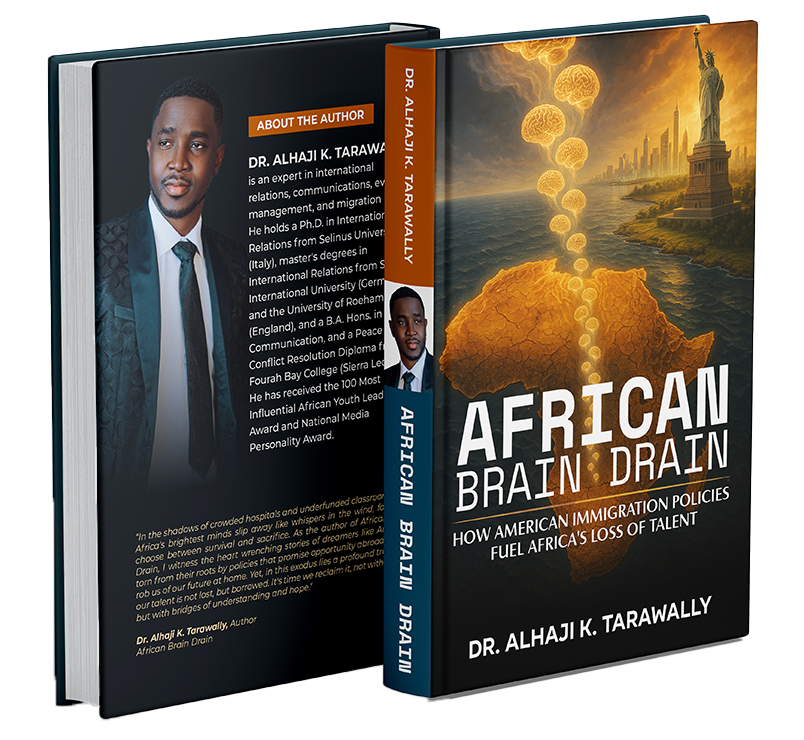
By Alhaji K. Tarawally, PhD
This is Africa’s reclamation plan against the pull of U.S. migration—a vision from a Sierra Leonean perspective. In an era of globalization, the ease with which skilled individuals from sub-Saharan African countries can relocate abroad has reached a critical point. American immigration policies have strategically attracted talent to address labor shortages, thereby exacerbating the brain drain from Africa. Factors such as poverty, war, disease, political persecution, and the lure of a better life drive Africa’s brightest minds to seek opportunities overseas. Unfortunately, these policies often turn short-term visits into permanent departures, leaving countries like Sierra Leone, Nigeria, Ghana, Kenya, Gambia, South Africa, Zimbabwe, and Egypt in urgent need of innovative and educated professionals essential for national development.
I am excited to announce that my first book is now officially available in print-on-demand paperback, hardcover, and as a Kindle edition on Apple Books and Amazon’s global marketplace. This book examines how U.S. immigration policies contribute to the brain drain from sub-Saharan Africa. It explores the key factors that push individuals away from their home countries and attract them to the United States, while also suggesting practical policy solutions.
At its core, this book illustrates how U.S. immigration policies serve as a strong magnet for highly educated professionals from sub-Saharan Africa, exacerbating the issue of brain drain. This term, first used by the British Royal Society in the 1950s to describe skilled Europeans migrating to North America, now highlights the challenges faced by Africa. The book examines various push factors, such as economic instability, limited job opportunities, and inadequate infrastructure in countries like Sierra Leone, alongside pull factors, including higher salaries, better resources, and career prospects in the U.S.
Through a fresh perspective, my book contributes new insights to global academia, addressing topics such as migration, economics, international relations, and diplomacy. The scale of this migration is concerning, supported by solid data. The World Bank reported in 2007 that approximately 3 million documented Africans reside in North America, primarily from sub-Saharan Africa. More recent research by Tankwanchi (2013) from Vanderbilt University revealed a 40% increase in the migration of educated doctors from 28 sub-Saharan African countries to the U.S. over the past decade, often surpassing the total number of doctors in some of these nations. The International Organization for Migration (IOM) estimates that by 2026, around 4.2 million sub-Saharan African immigrants will be in the U.S., making up 10% of the foreign-born population. These immigrants tend to be highly qualified, with higher education levels and stronger workforce participation than the average U.S. immigrant (Lorenzi & Batalova, 2022). Currently, it is estimated that 40% of sub-Saharan Africa’s top talent, including scientists and engineers, live abroad, with many from West Africa, particularly Sierra Leone, building careers in the U.S. (Benedict & Upkere, 2012; El-Khawas, 2004).
The book not only diagnoses the problem but also prescribes solutions for change. It discusses the benefits of remittances—money that migrants send home to support their families and stimulate local economies. However, it also warns of the long-term damage that could arise, such as Sierra Leone’s struggles to retain skilled workers. To tackle this issue, the book proposes practical solutions like incentives for returnees, improvement of local education systems, and agreements between African countries and the U.S. These solutions offer hope in the ongoing fight against brain drain.
My vision for this work is to transform brain drain into brain gain. For Sierra Leone, this means fostering stronger capacity building, driving economic progress, and enhancing healthcare and education—aligning with the goals of the Economic Community of West African States (ECOWAS). This book positions Sierra Leone as a potential leader in leveraging diaspora knowledge for development, setting a precedent for other African nations.
My personal journey adds depth to this project. Nearly eight years after earning my double master’s degrees and PhD in Germany, the UK, Italy, and the U.S., I am thrilled to reach this milestone. My diverse experiences, particularly in migration research and development in Sierra Leone, make this book a reliable and practical guide that effectively bridges theory and reality. It invites educators, policymakers, and students worldwide to engage in the conversation about Africa’s migration narrative, fostering a more inclusive global dialogue.
In summary, this book is more than a critique; it is a catalyst for change. It serves as a call to action aimed at helping Africa retain and attract talent. By encouraging a reevaluation of immigration policies, it seeks to ensure that sub-Saharan Africa’s intellectual resources benefit the region first. As excitement around its release builds, Dr. Alhaji K. Tarawally’s book inspires change, demonstrating how one voice from Sierra Leone can resonate across continents and ignite a movement towards a more equitable distribution of talent.